Want to learn more about the differences between polymer vs. thermoplastic cabinets, or between melamine and polyester? You’ve come to the right place!
ROCHON, a kitchen and bathroom designer in Quebec, explains the differences between each material and helps you choose the one that best suits your renovation project.
In brief
- Melamine is the most affordable option, ideal for tight budgets. Good durability when edge banding is properly sealed.
- Polyester closely mimics the look of wood and offers excellent value for money. Popular for shaker-style doors.
- Polymer is the most in-demand material in 2026: modern look, fingerprint-resistant, excellent durability.
- Thermoplastic offers superior moisture resistance (no edge banding), but is sensitive to extreme heat.
- Price: melamine and polyester are more affordable; polymer and thermoplastic cost more, but the investment is well justified.
- Estimated lifespan: melamine 10-15 years, polyester 15-20 years, polymer 20-25 years, thermoplastic 15-20 years.
Summary
- In brief
- Polymer, polyester, thermoplastic or melamine cabinets: manufacturing processes
- The appearance of these materials
- 2026 kitchen cabinet trends
- Durability
- Estimated lifespan by material
- Cabinet maintenance
- Costs of thermoplastic vs. melamine cabinets
- Eco-responsibility: which material to choose?
- Which material for your type of project?
- What is the best material for kitchen or bathroom cabinets?
- Frequently asked questions (FAQ)
Summary
- In brief
- Polymer, polyester, thermoplastic or melamine cabinets: manufacturing processes
- The appearance of these materials
- 2026 kitchen cabinet trends
- Durability
- Estimated lifespan by material
- Cabinet maintenance
- Costs of thermoplastic vs. melamine cabinets
- Eco-responsibility: which material to choose?
- Which material for your type of project?
- What is the best material for kitchen or bathroom cabinets?
- Frequently asked questions (FAQ)
Polymer, polyester, thermoplastic or melamine cabinets: manufacturing processes
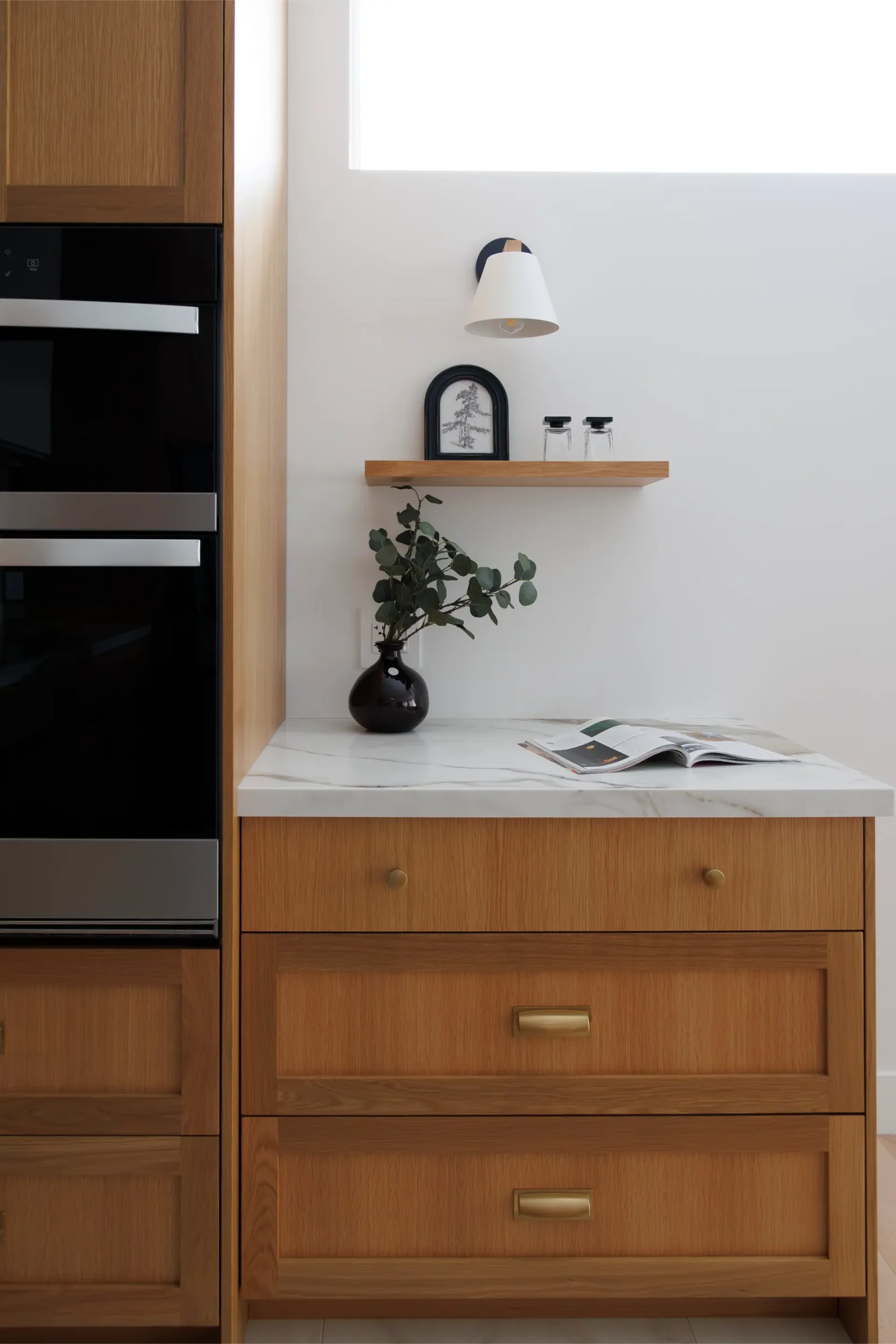
Each material has its own unique manufacturing process. Melamine is a panel made of compressed wood particles covered with a decorative paper and resin — this resin is called melamine, which gives the material its name.
Polyester is known for its appearance that closely resembles wood. It is most commonly found in five-piece (shaker) doors. Polyester consists of a melamine panel and an MDF frame, covered with a polyester sheet.
As for polymer, it is a medium-density fibre panel moulded from a flexible polymer particle. Polymer and thermoplastic are very similar materials, but with some differences in their properties. In fact, thermoplastic is a type of polymer that hardens or softens when exposed to heat or cold.


Explore our completed projects:
The appearance of these materials
When the time comes to renovate your bathroom or kitchen, appearance is a factor not to be overlooked. To keep loving your cabinets for years to come, it is essential to make the right choice of materials, as well as colour and door style.
Cabinet door materials are available in a wide selection of colours, so you can coordinate each one with the colours in your room. Here are the various options available to you:
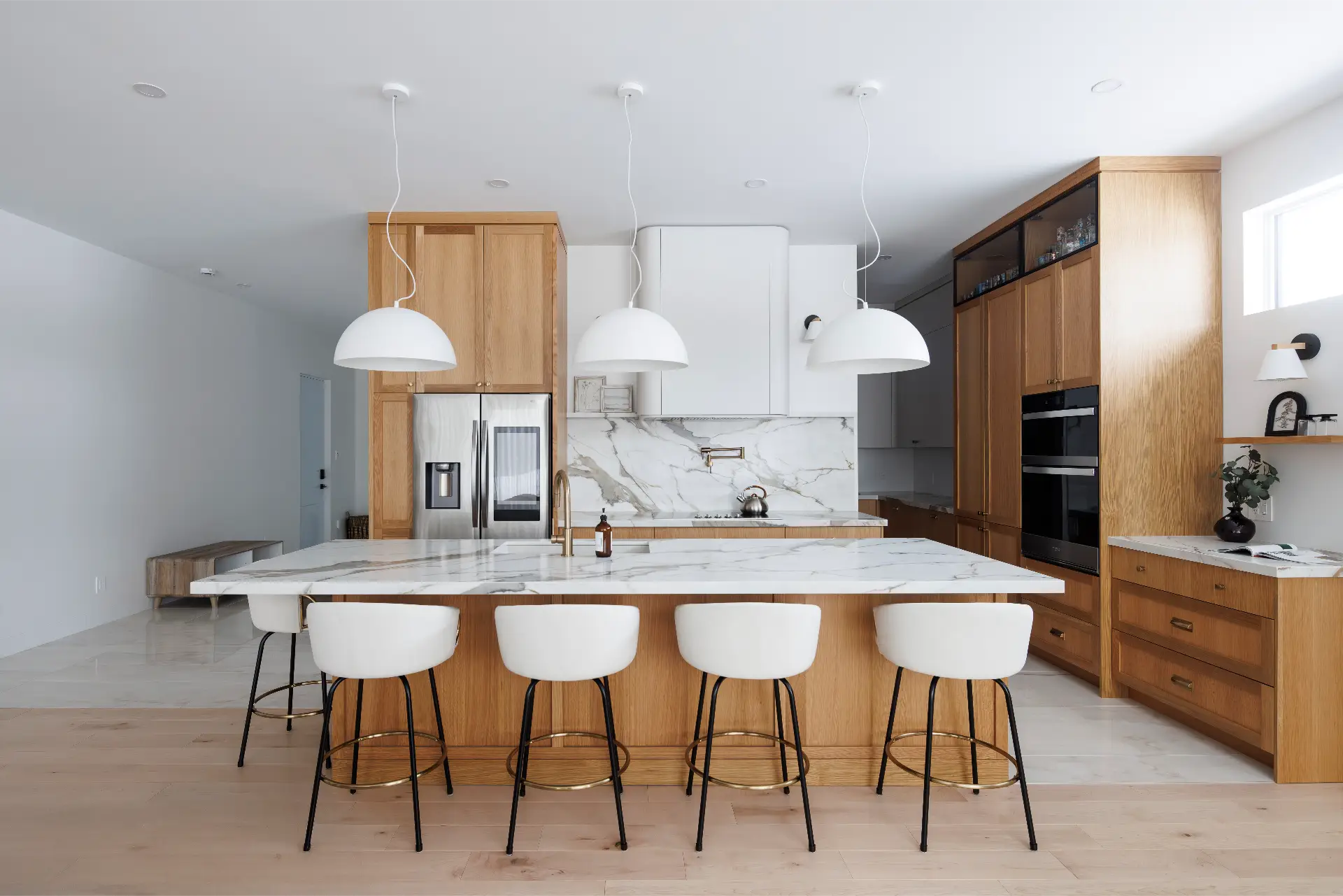
Melamine is a good choice if you want the look of wood. There are also several solid colour options in melamine, allowing you to mix colours and textures.
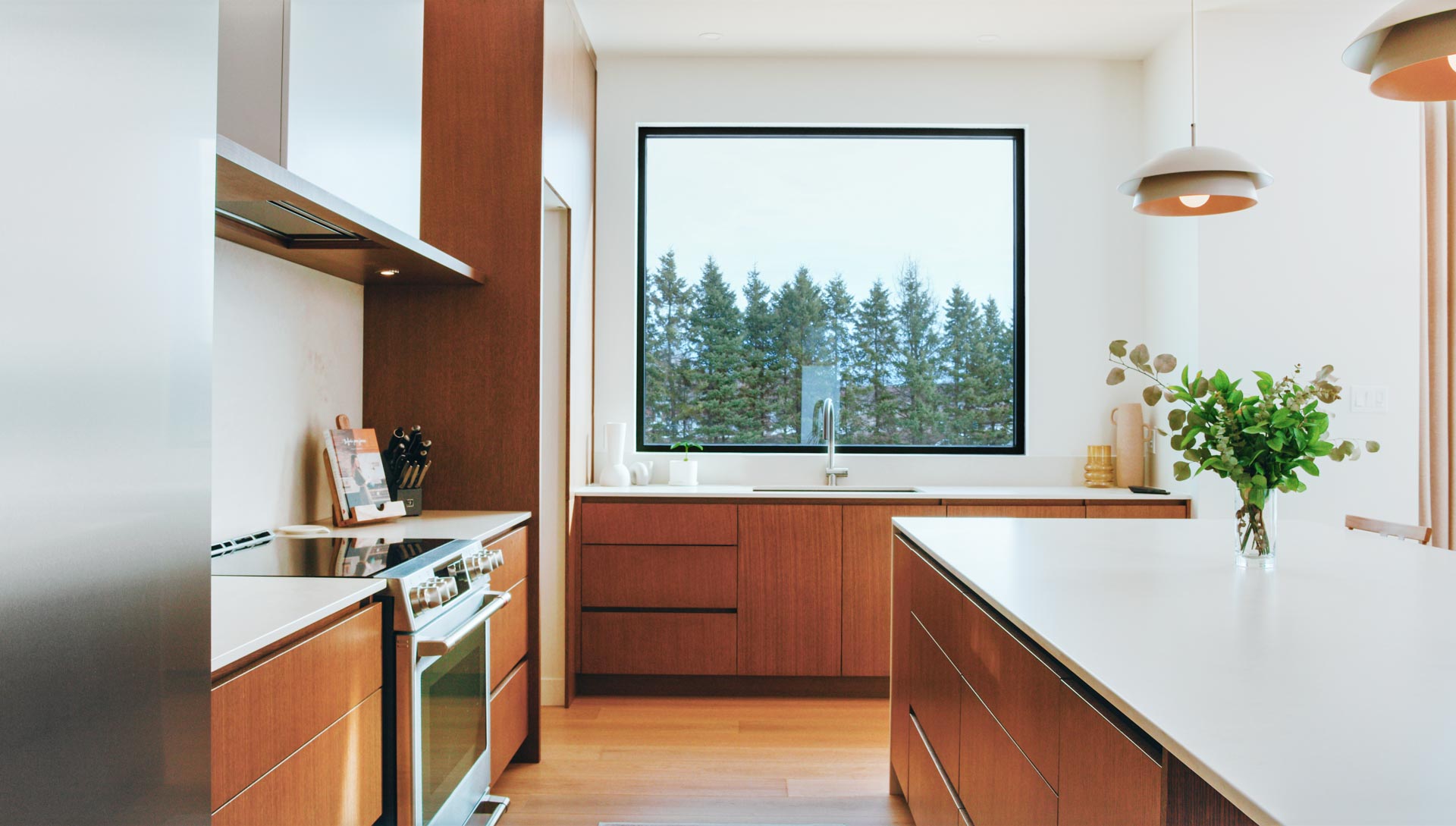
Polymer is an increasingly popular choice for kitchen design. Polymer cabinets are highly appreciated for their modern style, as well as their matte or glossy finish.
Thermoplastic, for its part, can offer a wide variety of finishes. It can mimic the look of wood or offer a completely solid-colour design.
Finally, polyester is another option for those who want to reproduce the look of wood in their decor. Like thermoplastic, it allows you to choose from a wide variety of solid colours. However, it offers slightly less freedom when it comes to creating patterns or textures.
In short, each material offers several different designs depending on the style and finish you desire.
2026 kitchen cabinet trends
The kitchen cabinet market is evolving rapidly. Here is what is dominating in 2026:
- Polymer is THE most in-demand material in recent years for kitchen and bathroom renovation projects in Quebec. Its contemporary matte finish and fingerprint-resistant properties are winning over an increasingly wide clientele.
- Matte and ultra-matte finishes continue to assert themselves, at the expense of glossy finishes that were popular a few years ago.
- Trending colours: warm tones (beige, cream, greige), sage green, midnight blue, and matte black. White remains a timeless classic, but homeowners are increasingly daring with colour.
- The shaker style remains the most popular door model in Quebec, often made in polyester for its value for money.
- The two-tone trend: combining two cabinet colours (for example, dark upper cabinets with light lower cabinets) to create contrast and depth.


See this year’s trending colours for kitchen cabinets
Durability
Moisture resistance, stain resistance, and heat resistance are the three key criteria for determining the durability of a cabinet material.
In general, polyester and polymer offer excellent durability. Additionally, polymer is also well known for its fingerprint-resistant properties.
Moisture resistance
Thermoplastic is moulded directly into the desired shape, which means there is no edge banding needed to cover panel edges, offering excellent moisture resistance.
Generally, edge banding makes doors less resistant to moisture and water infiltration. However, at ROCHON, we use a technology that offers an unmatched finish with laser-fused edge banding. The edge cannot peel off, making the doors highly resistant to moisture.
Stain resistance
In general, all options are stain-resistant and designed to be easy to clean. Some materials will be more resistant to stains than others.
It is important to discuss your needs with your designer to choose the right material for your project. For example, material recommendations will differ for a commercial space versus a home kitchen.
Heat resistance
All four materials are resistant to indirect heat. However, thermoplastic can warp or peel when exposed to extreme heat. Extra care should be taken with this material. If you are looking for a similar but slightly more heat-resistant alternative, polyester may be a better fit.
Estimated lifespan by material
The longevity of your cabinets depends on the quality of the manufacturer, the intensity of use, and maintenance. ROCHON manufactures its own kitchen cabinets in its workshop in Quebec City, allowing it to offer premium cabinets at an accessible price, with no middleman.
Here are realistic estimates for standard to high-quality cabinets:
- Melamine: 10 to 15 years. It is the material that wears out most quickly, especially at the edges, which can peel over time if the seal is not optimal.
- Polyester: 15 to 20 years. More durable than melamine, polyester maintains its appearance well over time. Its five-piece assembly gives it superior structural strength.
- Polymer: 20 to 25 years. The most durable of the four synthetic options. Its resistance to fingerprints and stains, combined with its quality finish, make it a long-term investment.
- Thermoplastic: 15 to 20 years. Good overall durability, but its sensitivity to extreme heat (proximity to the oven, toaster) can reduce its lifespan if precautions are not taken.
When considering the price relative to the lifespan, polymer often offers the best cost-per-year-of-use ratio, despite its higher initial price.

Cabinet maintenance
For active families, synthetic materials are an excellent choice for ease of maintenance. However, since manufacturing techniques for panels vary from one manufacturer to another, the quality of each product will differ. This will have a direct impact on the maintenance and lifespan of your cabinets. It is important to be well informed by your cabinetmaker or designer in order to choose the right product for your project.
Detailed maintenance guide by material
Melamine Cabinets:
- Daily cleaning: damp cloth with diluted mild soap.
- Avoid: abrasive products, scouring pads, undiluted bleach.
- Special attention: wipe up any liquid spills near the edges promptly to prevent water infiltration.
Polyester Cabinets:
- Daily cleaning: soft damp cloth, mild soap, or non-abrasive all-purpose cleaner.
- Avoid: solvents, acetone, and products containing ammonia.
- Tip: microfibre cloths are ideal for a streak-free finish.
Polymer Cabinets:
- Daily cleaning: a damp cloth is sufficient in most cases, thanks to the fingerprint-resistant property.
- For stubborn stains: a 50/50 mixture of water and white vinegar works well.
- Advantage: this is the material that requires the least daily maintenance effort.
Thermoplastic Cabinets:
- Daily cleaning: damp cloth with mild soap.
- Absolutely avoid: never place a hot appliance (toaster, coffee maker) directly against the surface. Heat can warp or cause the thermoplastic to peel.
- Precaution: keep intense heat sources away from cabinet doors.
Costs of thermoplastic vs. melamine cabinets
Price is an important factor to consider when choosing the right material for your project.
Generally, melamine and polyester are more economical options, although higher-end melamine is also available.
On the other hand, polymer and thermoplastic cabinets are generally more expensive. Of course, these materials offer several advantages that well justify their somewhat higher price.
In short, the cost of a kitchen renovation varies greatly depending on the choice of materials.
Plan your budget with our article on kitchen renovation costs


Eco-responsibility: which material to choose?
For environmentally conscious homeowners, here is what you need to know about the ecological impact of each material:
- Local manufacturing: in Quebec, several cabinet manufacturers produce locally, which significantly reduces the carbon footprint associated with transportation. At ROCHON, our high-quality kitchen cabinets, which meet Canadian standards, are manufactured in our workshop in Quebec City.
- Recyclability: melamine and MDF (the base for polymer and thermoplastic) are recyclable in some facilities, but options vary by municipality.
- Certifications: look for FSC (Forest Stewardship Council) certification for wood, and GREENGUARD certification for low volatile organic compound (VOC) emissions.
- Durability as an eco-factor: a material that lasts 20-25 years (polymer) has a lower environmental impact than one that needs to be replaced every 10-15 years (entry-level melamine).
- Resurfacing: if your cabinet boxes are still in good shape, resurfacing the doors reduces the amount of waste sent to landfill.
Which material for your type of project?
To help you choose quickly, here are our recommendations based on your situation:
- Active family kitchen (children, heavy use): Polymer. Its resistance to fingerprints and stains, combined with its easy maintenance, make it the #1 choice for families.
- Tight budget / first purchase: The best price for a satisfying aesthetic result. Choose a quality manufacturer with properly applied edge banding.
- Bathroom (humid environment): Polymer or thermoplastic. Their moisture resistance is superior. Thermoplastic is particularly well suited thanks to the absence of edge banding.
- Shaker / classic-style kitchen: Its wood-like appearance and five-piece assembly make it the natural choice for this door style.
- Modern, minimalist kitchen: Polymer in a matte finish. The contemporary look and variety of solid colours are a perfect fit.
- Commercial space or high-traffic area: Discuss with your ROCHON designer, as recommendations vary based on the intensity of use.
- High-end / prestige kitchen: High-end polymer, lacquered, or solid wood. The choice depends on the desired style and available budget.
What is the best material for kitchen or bathroom cabinets?
Several factors should influence your choice between polymer, polyester, thermoplastic, and melamine.
First, the aesthetics of the four materials can be quite different. Since the appearance of your cabinets is an element not to be overlooked in your renovation project, it is clear that the aesthetics of the material will influence your choice.
Next, the price of each option should also be considered. For example, polymer is a more expensive option. You might therefore opt for melamine or polyester if your budget is a bit tighter.
There is no objectively better option for your kitchen. To help you make an informed choice, here is a comparison table that quickly presents the advantages (+) and disadvantages (-) of all four materials:
| Characteristics | Melamine | Polyester | Polymer | Thermoplastic |
|---|---|---|---|---|
| Price | + | + | – | – |
| Durability | – | + | + | – |
| Heat Resistance | + | – | – | – |
| Moisture Resistance | – | + | + | – |
| Stain Resistance | + | + | + | + |
| Design Options | + | – | + | – |
| Lifespan | – | + | + | + |
| Fingerprint-Resistant | – | – | + | – |
Get inspired with our renovation photos
For your renovation needs in Quebec City, Montreal, and Gatineau, trust ROCHON, Cuisines et salles de bain. Our partner Gereco Construction can assist you with all related work: electrical, plumbing, and more.
Contact us today to schedule a consultation with one of our designers.
Frequently asked questions (FAQ)
Which cabinet material is most resistant to moisture?
Thermoplastic and polymer offer the best moisture resistance. Thermoplastic is particularly effective thanks to the absence of edge banding: the membrane is moulded directly onto the panel, eliminating infiltration points. At ROCHON, our polymer doors also benefit from laser-fused edge banding technology, making them highly water-resistant. Melamine is the most vulnerable to moisture if the edges are not properly sealed.
Can you repaint melamine cabinets?
Yes, but it requires thorough preparation. You first need to degrease the surfaces, then apply an adhesion primer specifically designed for smooth surfaces, and finally apply a quality paint (alkyd-acrylic or cabinet paint). The result can be satisfactory for a temporary refresh, but paint on melamine will never have the durability of a factory-made polymer or polyester door. If you are considering a lasting change, professional resurfacing is a better option.
Polymer or thermoplastic: which one to choose?
Both materials are very similar in composition, but they present important differences. Polymer offers better heat resistance and fingerprint resistance, a more modern look, and a slightly longer lifespan. Thermoplastic offers excellent moisture resistance (thanks to the absence of edge banding) and a wide variety of finishes. If heat is a factor (proximity to the oven or toaster), choose polymer. If you are looking for a material for the bathroom, thermoplastic is an excellent choice.
What is the warranty on cabinets?
The warranty varies depending on the manufacturer and the material. In general, Quebec manufacturers offer a 5 to 10-year warranty on cabinets, covering manufacturing defects. Some high-end polymer manufacturers offer warranties of up to 15 years. Contact us to learn more about the ROCHON warranty.
Are the cabinets manufactured in Quebec?
At ROCHON, we manufacture our cabinets in our workshop in Quebec City. Local manufacturing offers several advantages: shorter delivery times, rigorous quality control, accessible after-sales service, and a reduced environmental impact.
How do I know if my cabinets need to be replaced or if resurfacing is enough?
If the cabinet boxes (the cabinet carcass) are still solid, straight, and free of water damage, resurfacing is likely sufficient. This technique replaces only the doors, drawer fronts, and hardware, at approximately 40% of the cost of a full replacement. On the other hand, if the boxes are warped, water-damaged, or the kitchen layout no longer suits your needs, a complete replacement is recommended. A ROCHON designer can assess the condition of your cabinets during a complimentary consultation.